

 Image 1 of 6
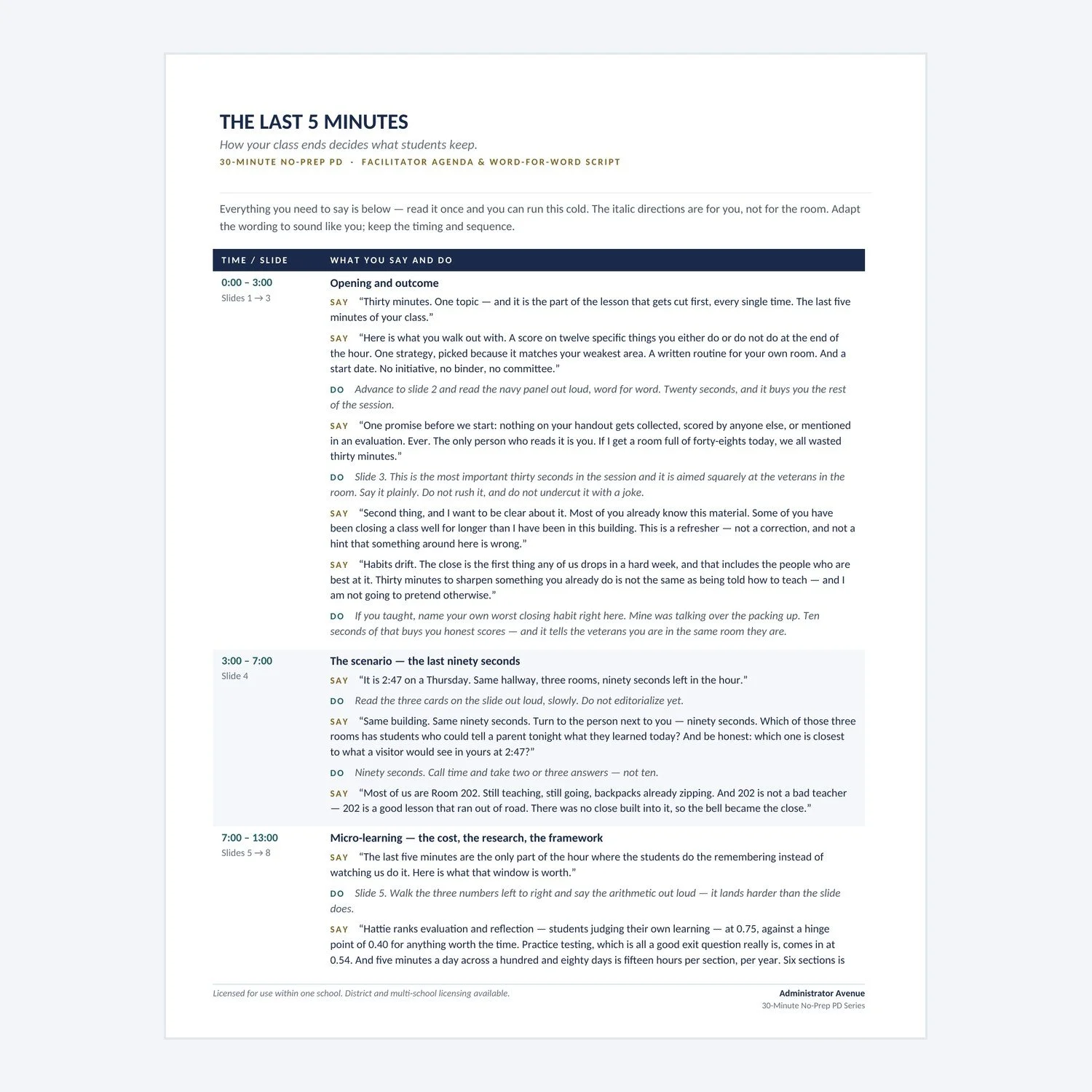 Image 2 of 6
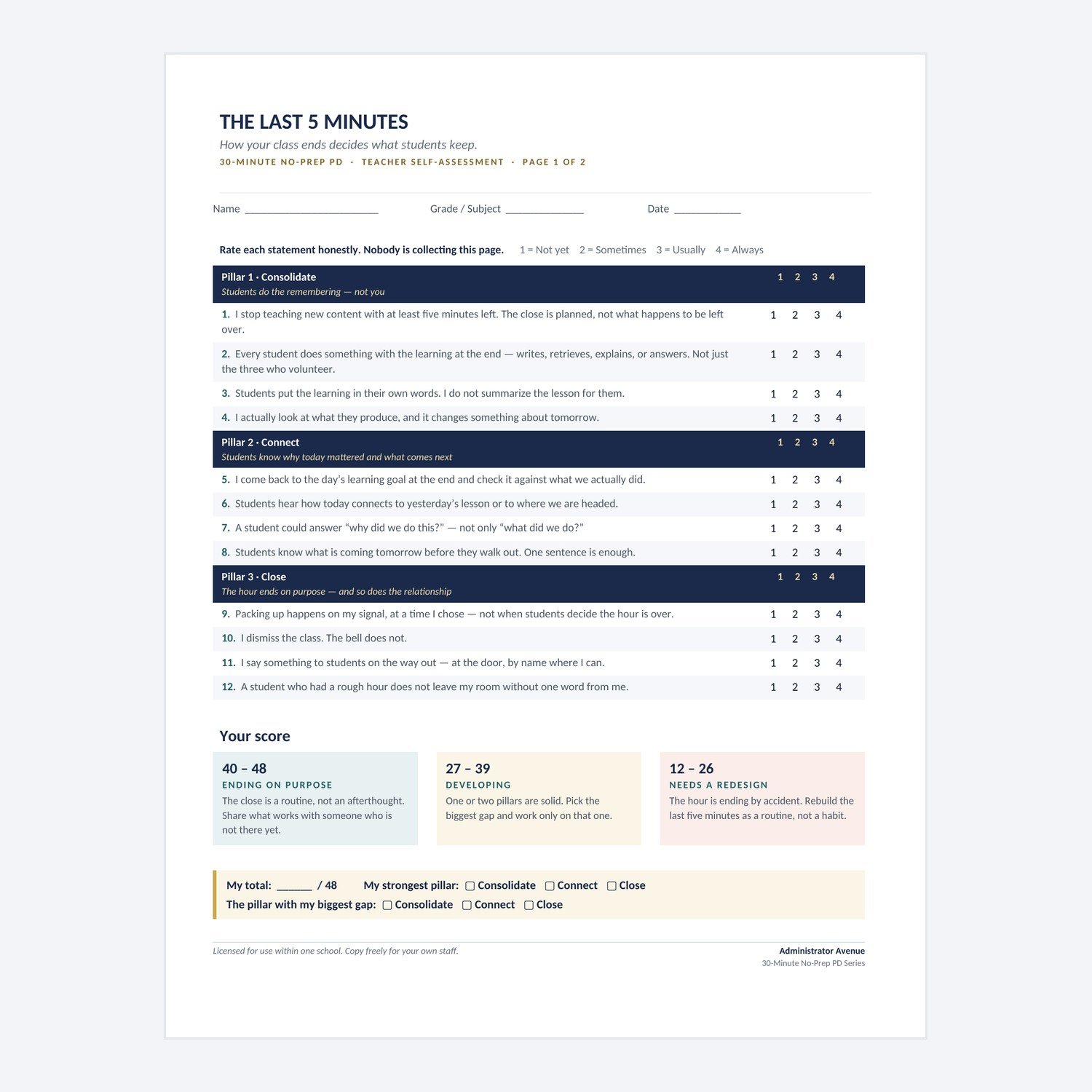 Image 3 of 6
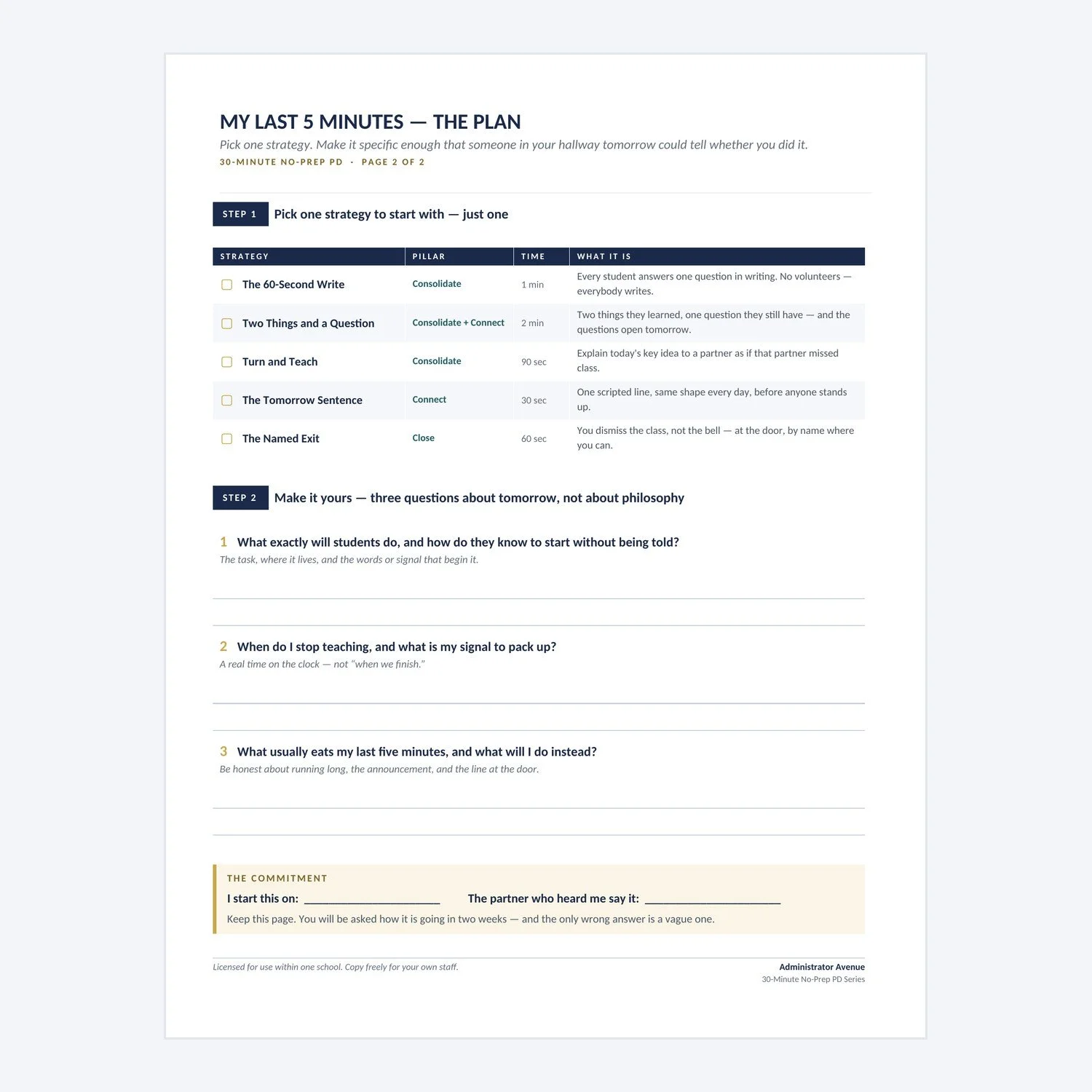 Image 4 of 6
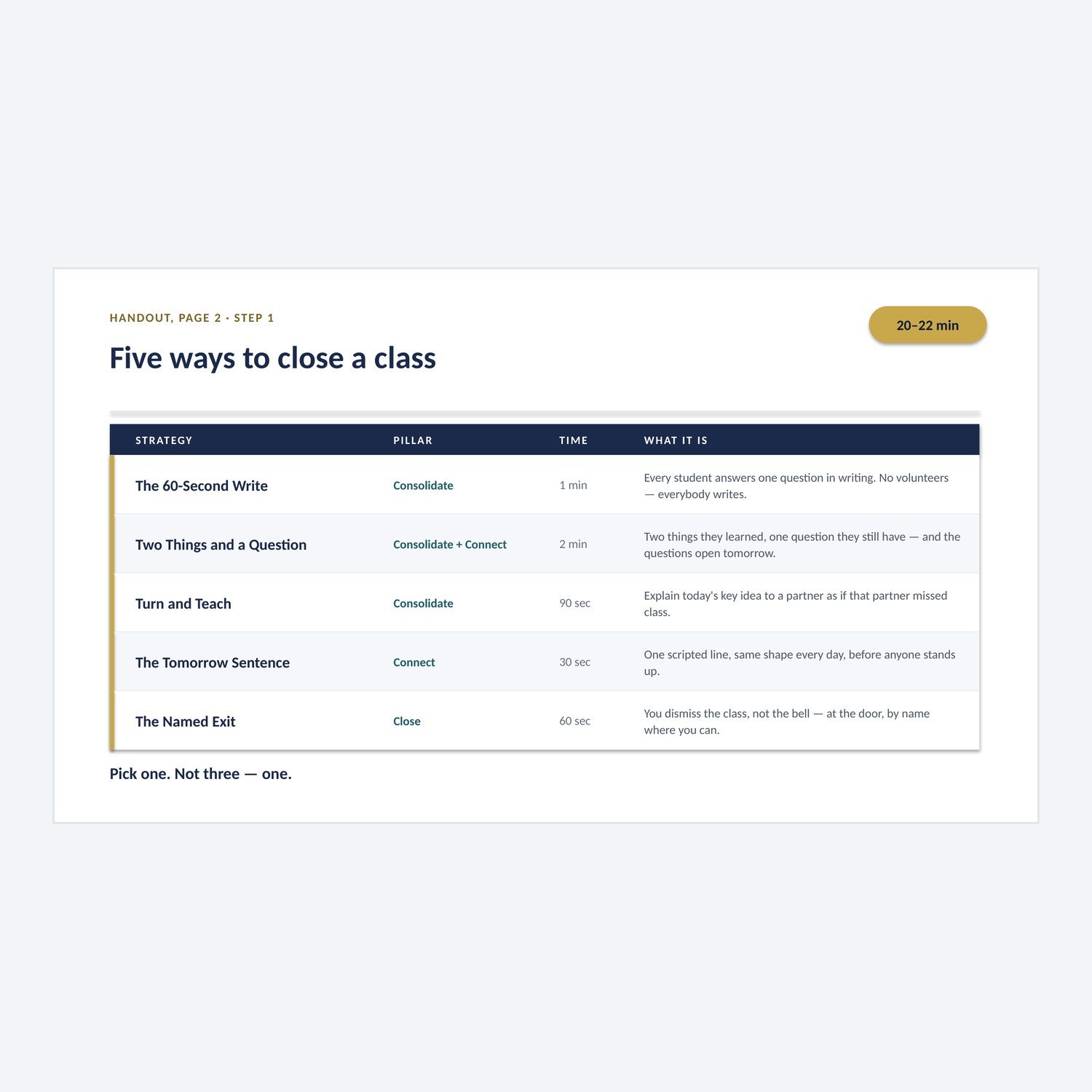 Image 5 of 6
 Image 6 of 6
The Last Five Minutes: 30 Min | NO PREP PD
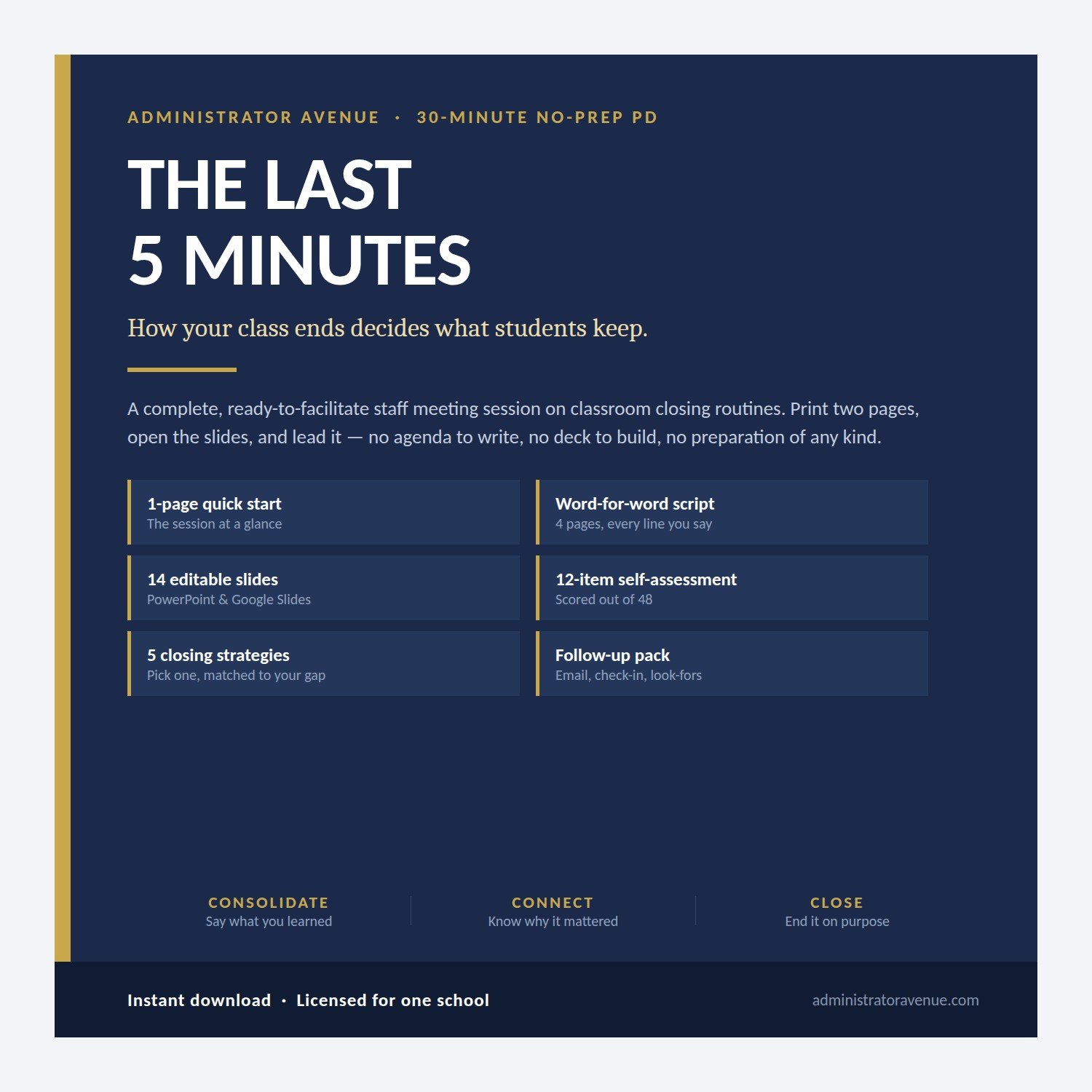
The Last 5 Minutes is a complete, ready-to-facilitate 30-minute professional development session on classroom closing routines.
A principal prints two pages, opens the slides, and leads it — no agenda to write, no deck to build, no preparation of any kind. Every teacher leaves with a scored self-assessment, one chosen strategy, and a written closing routine for their own classroom.
It is built on the part of the lesson that gets cut first, every single time. The last five minutes are the only stretch of the hour where students do the remembering instead of watching the teacher do it — and in most classrooms, the bell ends the lesson rather than the teacher. This session gives that window back, and it does it in one staff meeting.
What is included in the kit?
Principal quick start — one page. The session at a glance, the two minutes of prep, and four cautions. Read it once and you can run the session cold.
Word-for-word facilitator script — four pages. Every line, every transition, every timing cue, plus a facilitator reference sheet with the five objections teachers actually raise and a "best if / watch for" note on each strategy.
Editable slide deck — fourteen slides. PowerPoint and Google Slides, with visible timing on every slide and a school-name placeholder on the title.
Teacher self-assessment — twelve items across the three pillars, scored out of 48, with interpretation bands. Nothing is collected.
Five closing strategies — named, timed, and tagged to the pillar each one fixes. Teachers pick one; they are not handed a philosophy and told to figure it out.
Closing routine planning page — three prompts that produce an observable routine, plus a start date and a partner witness.
Follow-up pack — a ready-to-send staff email, a newsletter paragraph, a scripted five-minute check-in for two weeks later, and five things to look for on a walkthrough.
Alternate versions — twenty-minute, virtual, and PLC adaptations built into the script.
How does the 30 minutes run?
0:00–3:00 — Opening and outcome, including the plain statement that this is a refresher, not a correction.
3:00–7:00 — The scenario: the last ninety seconds in three classrooms at 2:47 p.m.
7:00–13:00 — What the closing window is worth, why the close most of us default to is the weakest one available, and the three pillars.
13:00–20:00 — Twelve-item self-assessment in silence, then Notice–Name–Next step with a partner.
20:00–22:00 — Five closing strategies. Each teacher picks the one that matches the pillar they just circled.
22:00–26:00 — Write the routine.
26:00–28:00 — Rehearse the last thirty seconds out loud, including the dismissal.
28:00–30:00 — Start date, partner witness, and the two-week follow-up.
You end the meeting on purpose, with time to spare — which is the same thing you have just spent thirty minutes asking teachers to do.
What are the five closing strategies?
Most PD on this topic hands teachers a principle and wishes them luck. This one hands them a short menu and asks them to pick the one that fixes their own weakest area.
The 60-Second Write — every student answers one question in writing. No volunteers, everybody writes. (Fixes Consolidate · 1 minute)
Two Things and a Question — two things they learned, one question still open. The questions open tomorrow's class. (Fixes Consolidate and Connect · 2 minutes)
Turn and Teach — students explain today's key idea to a partner as if that partner missed class. (Fixes Consolidate · 90 seconds)
The Tomorrow Sentence — one scripted line, the same shape every day, before anyone stands up. (Fixes Connect · 30 seconds)
The Named Exit — you dismiss the class, not the bell. At the door, by name where you can. (Fixes Close · 60 seconds)
None of them require materials. None of them are new. What is new is choosing one on purpose instead of taking whatever the clock leaves you.
Will my veteran staff think this is a criticism?
Not if you run it as written, because the session says the quiet part out loud in the first ninety seconds.
Slide three exists for exactly this. It states plainly that most of the room already knows this material, that some of them have been closing a class well for decades, and that this is a refresher rather than a correction. The script gives you the words, and it tells you not to rush them and not to undercut them with a joke.
The framing is honest, not a device. Habits drift, and the close is the first thing any of us drops in a hard week — including the people who are best at it. The teachers who get the most out of thirty minutes like this are usually the ones who were already good at it, because they are the ones who notice the smallest gaps.
The script also gives you the answer for the teacher who says it out loud: "I have been teaching twenty-two years. I know how to end a class."
What do teachers walk out with?
A scored self-assessment they keep, one chosen strategy, a written closing routine for their own classroom, a start date, and one colleague who heard them say it out loud.
The plan is written to a standard: specific enough that a principal standing in the hallway at 2:47 the next day could tell whether it happened. Nothing gets collected, scored by anyone else, or referenced in an evaluation — and the handout says so in print, because the scores are only useful if they are honest.
The framework, in one line each:
Consolidate — can a student say what they just learned, in their own words, or did the teacher do the remembering for them?
Connect — do they know why today mattered, and what happens tomorrow?
Close — was the hour ended by a person, or by a bell?
Most teachers do one of these well. Some do two. Almost nobody does all three on purpose — and almost none of us were ever taught how to end a class in the first place.
How much preparation does it require?
Print the handout two-sided, one per teacher. Open the slides and add your school name. Read the quick start once. That is the entire preparation, and it takes about two minutes.
The facilitator script is written for a principal who has not read it before walking into the room. Every line you say is on the page, including the transitions, the timings, and the five objections teachers actually raise.
What is in the download:
Quick start guide — 1 page (PDF)
Facilitator script — 4 pages (PDF and editable Word)
Teacher handout — 2 pages (PDF and editable Word)
Slide deck — 14 slides (PowerPoint, opens in Google Slides)
Follow-up pack — 2 pages (PDF and editable Word)
Who is it for?
Principals, assistant principals, instructional coaches, department chairs, and team leaders. It runs in a staff meeting, department time, a PLC, or an institute day, and it works at any grade level and in any subject — the twelve behaviors are about how an hour ends, not about what was taught in it.
A kindergarten close might be a hand signal and one word each. An AP chemistry close might be a two-minute retrieval problem. The structure is identical.
Frequently asked questions
Do I need to know anything about the topic to lead it? No. Every line you say is written out. Read the quick start once — one page — and you can facilitate the session without preparing anything else.
Will my teachers think this is an evaluation? Not if you use the language in the script. The opening states plainly that nothing is collected, scored by anyone else, or referenced in an evaluation, and the handout says the same thing in print. The scores are only useful if they are honest.
Can I edit the slides and add our school branding? Yes. The deck is a standard PowerPoint file that opens in Google Slides, and the title slide has a school-name placeholder. The Word versions of the handout and script are editable too.
What if I only have twenty minutes? The script includes a twenty-minute version: cut the three-classroom scenario and trim the micro-learning. The self-assessment, the strategy choice, the writing, and the rehearsal all stay — those four are the session.
Does it work virtually? Yes. Send the handout as a PDF beforehand and use two-person breakout rooms for both partner segments. The script gives adjusted timings, since breakouts lose about thirty seconds on each end.
Can I use it with just one grade level or department? Yes, and the script adds one closing question for teams: if a student had all four of you in a single day, how many times would anyone ask them to say what they learned?
Our bell schedule is the real problem. Does this still work? It works because it refuses that argument. The script gives you the exact line for redirecting a schedule complaint, and the planning page asks teachers what usually eats their last five minutes — the intercom, running long, the line at the door — and what they will do instead. If the announcement fires at 2:50, the close is at 2:45.
What happens after the session? The follow-up pack handles it. Send the staff email within a day, run the scripted five-minute check-in two weeks later, and use the five walkthrough look-fors in between.
Can we buy it for more than one building? Yes. The standard license covers one school; district and multi-school licensing is available — email Joe and he will send terms.
The Last 5 Minutes is a complete, ready-to-facilitate 30-minute professional development session on classroom closing routines.
A principal prints two pages, opens the slides, and leads it — no agenda to write, no deck to build, no preparation of any kind. Every teacher leaves with a scored self-assessment, one chosen strategy, and a written closing routine for their own classroom.
It is built on the part of the lesson that gets cut first, every single time. The last five minutes are the only stretch of the hour where students do the remembering instead of watching the teacher do it — and in most classrooms, the bell ends the lesson rather than the teacher. This session gives that window back, and it does it in one staff meeting.
What is included in the kit?
Principal quick start — one page. The session at a glance, the two minutes of prep, and four cautions. Read it once and you can run the session cold.
Word-for-word facilitator script — four pages. Every line, every transition, every timing cue, plus a facilitator reference sheet with the five objections teachers actually raise and a "best if / watch for" note on each strategy.
Editable slide deck — fourteen slides. PowerPoint and Google Slides, with visible timing on every slide and a school-name placeholder on the title.
Teacher self-assessment — twelve items across the three pillars, scored out of 48, with interpretation bands. Nothing is collected.
Five closing strategies — named, timed, and tagged to the pillar each one fixes. Teachers pick one; they are not handed a philosophy and told to figure it out.
Closing routine planning page — three prompts that produce an observable routine, plus a start date and a partner witness.
Follow-up pack — a ready-to-send staff email, a newsletter paragraph, a scripted five-minute check-in for two weeks later, and five things to look for on a walkthrough.
Alternate versions — twenty-minute, virtual, and PLC adaptations built into the script.
How does the 30 minutes run?
0:00–3:00 — Opening and outcome, including the plain statement that this is a refresher, not a correction.
3:00–7:00 — The scenario: the last ninety seconds in three classrooms at 2:47 p.m.
7:00–13:00 — What the closing window is worth, why the close most of us default to is the weakest one available, and the three pillars.
13:00–20:00 — Twelve-item self-assessment in silence, then Notice–Name–Next step with a partner.
20:00–22:00 — Five closing strategies. Each teacher picks the one that matches the pillar they just circled.
22:00–26:00 — Write the routine.
26:00–28:00 — Rehearse the last thirty seconds out loud, including the dismissal.
28:00–30:00 — Start date, partner witness, and the two-week follow-up.
You end the meeting on purpose, with time to spare — which is the same thing you have just spent thirty minutes asking teachers to do.
What are the five closing strategies?
Most PD on this topic hands teachers a principle and wishes them luck. This one hands them a short menu and asks them to pick the one that fixes their own weakest area.
The 60-Second Write — every student answers one question in writing. No volunteers, everybody writes. (Fixes Consolidate · 1 minute)
Two Things and a Question — two things they learned, one question still open. The questions open tomorrow's class. (Fixes Consolidate and Connect · 2 minutes)
Turn and Teach — students explain today's key idea to a partner as if that partner missed class. (Fixes Consolidate · 90 seconds)
The Tomorrow Sentence — one scripted line, the same shape every day, before anyone stands up. (Fixes Connect · 30 seconds)
The Named Exit — you dismiss the class, not the bell. At the door, by name where you can. (Fixes Close · 60 seconds)
None of them require materials. None of them are new. What is new is choosing one on purpose instead of taking whatever the clock leaves you.
Will my veteran staff think this is a criticism?
Not if you run it as written, because the session says the quiet part out loud in the first ninety seconds.
Slide three exists for exactly this. It states plainly that most of the room already knows this material, that some of them have been closing a class well for decades, and that this is a refresher rather than a correction. The script gives you the words, and it tells you not to rush them and not to undercut them with a joke.
The framing is honest, not a device. Habits drift, and the close is the first thing any of us drops in a hard week — including the people who are best at it. The teachers who get the most out of thirty minutes like this are usually the ones who were already good at it, because they are the ones who notice the smallest gaps.
The script also gives you the answer for the teacher who says it out loud: "I have been teaching twenty-two years. I know how to end a class."
What do teachers walk out with?
A scored self-assessment they keep, one chosen strategy, a written closing routine for their own classroom, a start date, and one colleague who heard them say it out loud.
The plan is written to a standard: specific enough that a principal standing in the hallway at 2:47 the next day could tell whether it happened. Nothing gets collected, scored by anyone else, or referenced in an evaluation — and the handout says so in print, because the scores are only useful if they are honest.
The framework, in one line each:
Consolidate — can a student say what they just learned, in their own words, or did the teacher do the remembering for them?
Connect — do they know why today mattered, and what happens tomorrow?
Close — was the hour ended by a person, or by a bell?
Most teachers do one of these well. Some do two. Almost nobody does all three on purpose — and almost none of us were ever taught how to end a class in the first place.
How much preparation does it require?
Print the handout two-sided, one per teacher. Open the slides and add your school name. Read the quick start once. That is the entire preparation, and it takes about two minutes.
The facilitator script is written for a principal who has not read it before walking into the room. Every line you say is on the page, including the transitions, the timings, and the five objections teachers actually raise.
What is in the download:
Quick start guide — 1 page (PDF)
Facilitator script — 4 pages (PDF and editable Word)
Teacher handout — 2 pages (PDF and editable Word)
Slide deck — 14 slides (PowerPoint, opens in Google Slides)
Follow-up pack — 2 pages (PDF and editable Word)
Who is it for?
Principals, assistant principals, instructional coaches, department chairs, and team leaders. It runs in a staff meeting, department time, a PLC, or an institute day, and it works at any grade level and in any subject — the twelve behaviors are about how an hour ends, not about what was taught in it.
A kindergarten close might be a hand signal and one word each. An AP chemistry close might be a two-minute retrieval problem. The structure is identical.
Frequently asked questions
Do I need to know anything about the topic to lead it? No. Every line you say is written out. Read the quick start once — one page — and you can facilitate the session without preparing anything else.
Will my teachers think this is an evaluation? Not if you use the language in the script. The opening states plainly that nothing is collected, scored by anyone else, or referenced in an evaluation, and the handout says the same thing in print. The scores are only useful if they are honest.
Can I edit the slides and add our school branding? Yes. The deck is a standard PowerPoint file that opens in Google Slides, and the title slide has a school-name placeholder. The Word versions of the handout and script are editable too.
What if I only have twenty minutes? The script includes a twenty-minute version: cut the three-classroom scenario and trim the micro-learning. The self-assessment, the strategy choice, the writing, and the rehearsal all stay — those four are the session.
Does it work virtually? Yes. Send the handout as a PDF beforehand and use two-person breakout rooms for both partner segments. The script gives adjusted timings, since breakouts lose about thirty seconds on each end.
Can I use it with just one grade level or department? Yes, and the script adds one closing question for teams: if a student had all four of you in a single day, how many times would anyone ask them to say what they learned?
Our bell schedule is the real problem. Does this still work? It works because it refuses that argument. The script gives you the exact line for redirecting a schedule complaint, and the planning page asks teachers what usually eats their last five minutes — the intercom, running long, the line at the door — and what they will do instead. If the announcement fires at 2:50, the close is at 2:45.
What happens after the session? The follow-up pack handles it. Send the staff email within a day, run the scripted five-minute check-in two weeks later, and use the five walkthrough look-fors in between.
Can we buy it for more than one building? Yes. The standard license covers one school; district and multi-school licensing is available — email Joe and he will send terms.