

Invest in Your Administrators Before You Have to Replace Them

School districts invest a great deal of time, trust, and resources into hiring administrators.
A principal is not just a name on an organizational chart. A principal is a relationship-builder, decision-maker, communicator, culture-carrier, problem-solver, and daily point of stability for students, staff, and families.
So when an administrator leaves, the cost is rarely limited to posting the job and holding interviews.
The real cost is much bigger.
Districts can lose momentum. Staff may lose consistency. Families may lose a familiar point of contact. Students experience change. Central office teams spend time filling a gap instead of strengthening the system. And the new administrator, no matter how talented, needs time to learn the school, the people, the routines, the history, and the “why do we do it this way?” moments that never seem to make it into the handbook.
That is why investing in current administrators is not just a nice idea.
It is a smart district strategy.
Administrator Turnover Costs More Than a Job Posting
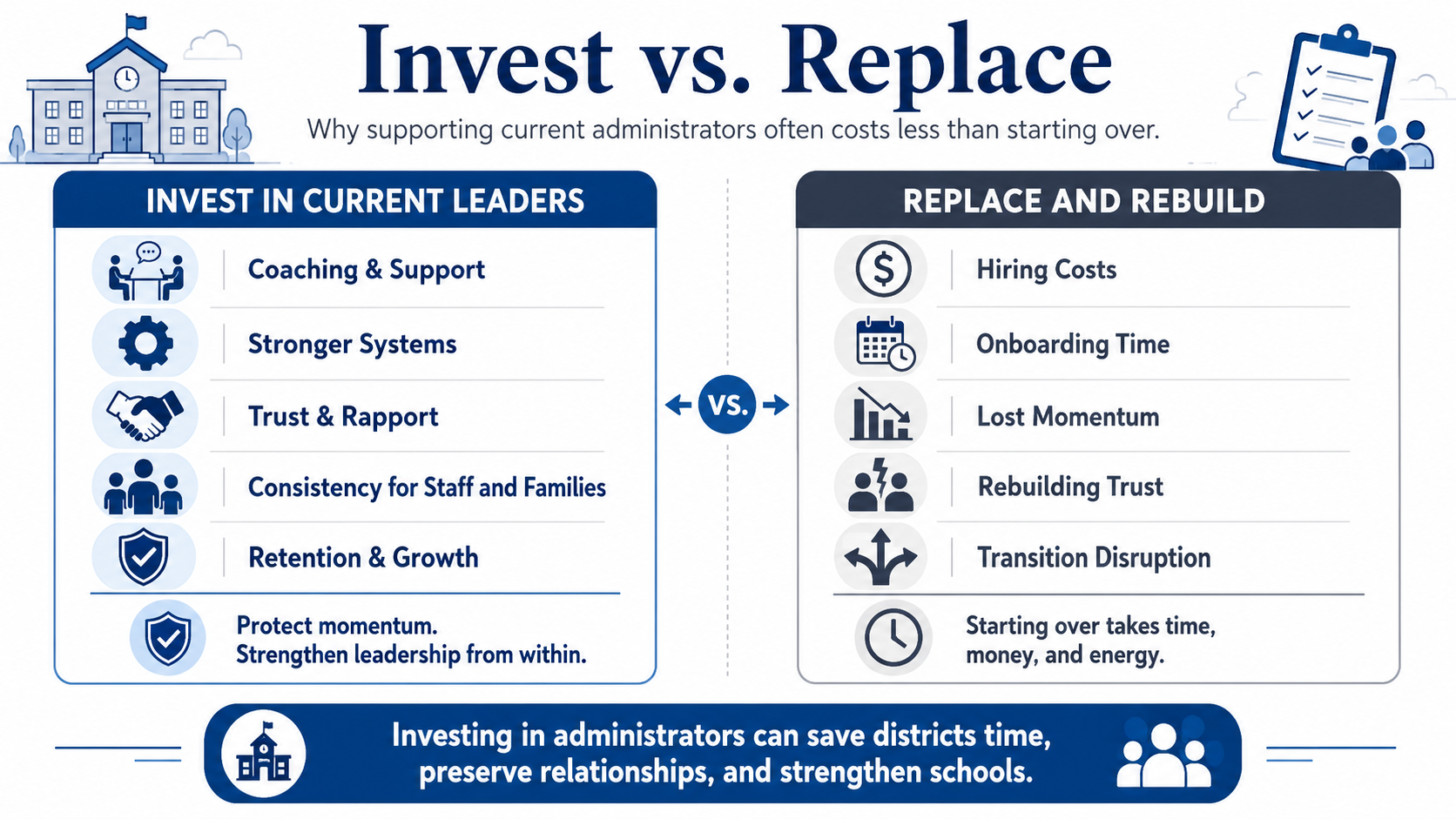
When an administrator leaves, there are obvious costs.
Districts spend time posting the position, screening applicants, organizing interviews, checking references, negotiating contracts, onboarding the new hire, and supporting the transition.
But the hidden costs can be even greater.
A district may lose years of school-specific knowledge. Staff may need time to rebuild trust with a new leader. Families may need to adjust to new communication patterns. Systems may pause or shift. Initiatives may slow down. The new administrator may need months, and sometimes longer, to fully understand the culture and context of the building.
In education, context matters.
An administrator who understands the staff, students, families, community expectations, district priorities, and school history is carrying valuable knowledge. When that person leaves, the district does not simply replace a position.
It often has to rebuild momentum.
Rapport and Trust Take Time to Build
One of the most overlooked values of a current administrator is rapport.
Rapport with staff.
Rapport with students.
Rapport with families.
Rapport with community partners.
Rapport with district leadership.
Those relationships do not appear in the first week on the job. They are built through hallway conversations, difficult meetings, consistent follow-through, visible presence, and a thousand small moments that create trust over time.
When an administrator leaves, that relational capital can be disrupted.
A new administrator may be excellent, but they still have to earn trust. Staff need to learn their leadership style. Families need to understand their communication patterns. Students need to see consistency. District leaders need to support the transition.
That takes time, patience, and energy.
Investing in current administrators helps protect the relationships that already exist. It sends a message that leadership stability matters and that the district is willing to support leaders before they reach a breaking point.
Supporting Current Leaders Saves Time
Time is one of the most limited resources in education.
When administrators are supported well, districts save time because fewer issues escalate unnecessarily. Leaders have clearer systems for discipline, communication, staff support, parent concerns, and follow-through. Principals are not constantly reinventing processes in isolation. District leaders do not have to step in as often to solve building-level issues that could be handled through stronger systems and coaching.
Every hour spent reacting to preventable problems is an hour not spent supporting instruction, building culture, mentoring staff, or planning ahead.
And let’s be honest: school leaders already have enough actual and metaphorical fire drills.
Investing in current administrators helps protect time before it disappears into the daily pace of school leadership.
Support Helps Administrators Stay and Grow
Administrators do not usually leave because they dislike students or do not care about schools.
Many leave because the role becomes too heavy, too isolated, or too reactive for too long.
The work can become overwhelming when leaders are expected to manage discipline, communication, staff concerns, parent concerns, operations, supervision, evaluations, safety, instruction, culture, and district initiatives without enough practical support.
Professional development matters, but administrators often need more than a one-day training.
They need usable systems.
They need coaching.
They need someone who understands the pace and pressure of the job.
They need tools that help them organize the work, communicate clearly, lead consistently, and move from constant reaction to proactive leadership.
Supporting administrators does not mean they are failing.
It means the district recognizes the importance of the role.
Strong leaders still need support. In fact, strong leaders often benefit the most from support because they are already committed to improving and serving their schools well.
What Support Can Look Like
Investing in administrators can take many practical forms.
A district might support a new principal by helping them build a 90-day entry plan, communication calendar, staff meeting structure, and discipline response system.
A district might support an experienced principal by helping refine systems that have become inconsistent, outdated, or too dependent on one person.
A district might support assistant principals by helping them develop confidence in communication, student discipline, parent meetings, documentation, and staff follow-through.
A district might support leadership teams by creating common language around expectations, accountability, communication, and problem-solving.
These are not always flashy changes.
But they are the kinds of changes that make schools feel more steady.
They help administrators lead with clarity. They help staff know what to expect. They help families receive more consistent communication. They help students experience more predictable systems. And they help districts keep good leaders in place.
Investing Is Usually Better Than Starting Over
Hiring a new administrator is sometimes necessary. There are situations where a leadership change is the right decision.
But replacing leaders should not become the main leadership development strategy.
Before a district reaches the point of replacing an administrator, it is worth asking:
Have we provided this leader with the tools, systems, coaching, and structure needed to succeed?
That question matters.
The best time to support an administrator is not after they are overwhelmed.
It is before the pressure becomes unsustainable.
It is before systems become inconsistent.
It is before staff frustration builds.
It is before families lose confidence.
It is before the district is forced into another hiring process.
Proactive support can protect leadership stability, strengthen school systems, and reduce the disruption that comes with turnover.
How Administrator Avenue Can Help

Administrator Avenue was built around a simple idea: school leaders need practical support that helps them lead with clarity, consistency, and confidence.
The goal is not to tell districts what they are doing wrong.
The goal is to partner with schools and districts to support administrators in a practical, sustainable way.
Through leadership coaching, systems development, communication planning, and the CALM Framework, Administrator Avenue helps school leaders build tools and processes that make the work more manageable.
That support may include helping leaders strengthen discipline systems, improve communication structures, organize staff support, build proactive plans, or create more consistent follow-through.
The purpose is simple:
Support the people already leading the work.
Because when administrators are supported, schools benefit.
And when schools benefit, students, staff, families, and districts benefit.
Final Thought
Replacing an administrator can be expensive.
Losing rapport can be disruptive.
Rebuilding trust takes time.
Starting over slows momentum.
Investing in current administrators is one of the most practical ways districts can protect their schools, strengthen leadership, and create more consistent systems.
Districts do not have to wait until a leader is burned out, overwhelmed, or ready to leave.
They can choose to support leaders while they are still leading.
And that investment may be one of the smartest decisions a district can make.
To learn more about practical leadership support, systems development, and the CALM Framework, visit Administrator Avenue at https://administratoravenue.com/.
Sources & Further Reading
NCES reported that 11% of public school principals from the 2020–21 school year had left the profession by the 2021–22 school year.
NCES also reported that 80% stayed at the same school and 6% moved to another school one year later.
NCES School Pulse Panel data showed that 69% of public schools reported difficulty filling one or more non-teaching vacancies before the 2024–25 school year.
