

The Hidden Cost of Reactive Leadership

School leadership comes with surprises.
A student situation pops up before the first bell. A parent email needs a careful response. A teacher needs support. A schedule changes. A behavior issue escalates. Someone needs coverage. Someone else needs clarification. And somewhere in the building, the copier jams at the exact moment everyone needs it most.
For principals and school leaders, responding to the unexpected is part of the job. No school day goes exactly as planned.
But when leadership becomes mostly reactive, the cost can quietly add up.
Reactive leadership is not a sign that leaders are not working hard. In many cases, it is the opposite. It is often a sign that leaders are carrying too much without the systems, structures, or support needed to stay ahead of recurring issues.
At Administrator Avenue, the focus is on helping school leaders build clearer responses, stronger systems, and more consistent school culture. That matters because leadership does not just set the tone for a school. Systems help sustain it.
What Is Reactive Leadership?
Reactive leadership happens when most decisions are made in response to the issue that is loudest, newest, or most urgent.
Instead of leading from a clear process, the day becomes driven by whatever problem shows up next.
In schools, reactive leadership can look like:
Addressing behavior issues only after they escalate
Responding to parent concerns only after frustration builds
Clarifying staff expectations only after confusion occurs
Creating procedures only after something goes wrong
Holding meetings only after people are already overwhelmed
Making case-by-case decisions because no consistent process exists
This does not mean the leader is doing something wrong. Schools are complex places. Administrators are managing people, emotions, schedules, student needs, family concerns, staff support, district expectations, and approximately 47 things that were supposed to be done yesterday.
The problem is not that school leaders have to respond.
The problem is when responding becomes the whole leadership model.
The Hidden Cost of Always Reacting
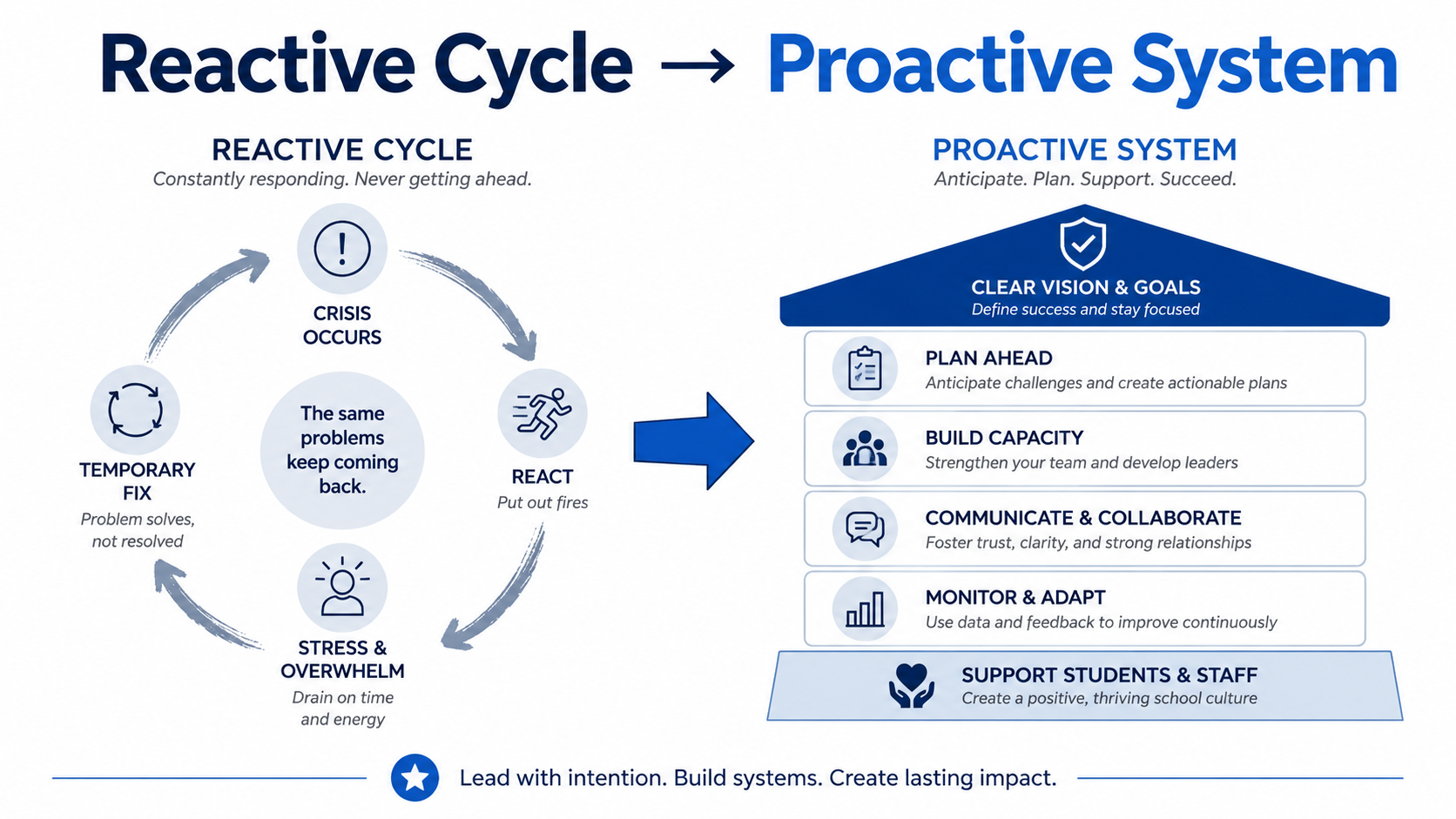
The biggest cost of reactive leadership is that it often looks productive on the surface.
Problems get solved. Emails get answered. Meetings happen. Students are supported. Staff members get direction. The day keeps moving.
But underneath the surface, reactive leadership creates pressure.
It can increase stress for administrators because every issue feels urgent. It can create frustration for staff because expectations may feel unclear or inconsistent. It can cause families to lose confidence when communication feels delayed or unpredictable. It can make students experience different responses depending on the adult, the day, or the situation.
Over time, reactive leadership can create a school culture where everyone is busy, but not always moving forward.
That is the hidden cost.
People are working hard, but the same problems keep returning.
Why Reactive Patterns Develop
Most school leaders do not choose to lead reactively.
Reactive patterns often develop when systems are unclear, inconsistent, or missing.
For example:
What happens when a student repeatedly disrupts class?
How are parent concerns documented and followed up on?
How does the leadership team communicate important decisions?
What is the process when a staff member needs support?
How are expectations taught, reviewed, and reinforced?
What happens after an incident is “resolved”?
When those answers are not clear, every situation requires a new decision. That places more pressure on administrators and creates inconsistency for staff, students, and families.
This is where schools can unintentionally move into a cycle of repeated problem-management.
The same issues come back, but the system underneath the issue never gets strengthened.
Leadership Stress Is Real
School leadership is deeply meaningful work, but it is also demanding work.
Research continues to show that principals and educators face high levels of job-related stress, workload pressure, and retention challenges. Principals also have a significant influence on teacher satisfaction, school climate, and student outcomes.
That means supporting school leaders is not just about helping one person manage a difficult role. It is about supporting the entire system around students, staff, and families.
When leaders are constantly reacting, they have less time and energy for the work that often matters most:
Coaching staff
Building culture
Improving instruction
Communicating proactively
Following up consistently
Strengthening systems
Developing leadership capacity in others
Reactive leadership steals time from proactive leadership.
And time is one thing school leaders never seem to have extra of. If someone ever finds the secret stash of extra principal time, please label it clearly and share it with the rest of us.
From Reactive Leadership to Proactive Systems
The goal is not to eliminate every surprise.
That would be nice, but schools are not exactly predictable environments.
The goal is to reduce the number of situations that require last-minute decisions.
That shift happens through stronger systems.
Proactive systems help school leaders:
Clarify expectations
Create consistent responses
Communicate more effectively
Support staff before frustration builds
Address student needs earlier
Reduce confusion for families
Improve follow-through
Identify patterns before they become bigger problems
This is the heart of CALM in Systems: building practical, easy-to-use systems that support administrators, staff, students, families, and communities.
Strong systems do not remove the human side of leadership. They support it.
They give leaders a clearer path to follow when things get difficult.
A Simple Example: Student Behavior
Student behavior is one of the clearest examples of the difference between reactive leadership and proactive systems.
In a reactive pattern, behavior concerns may be handled case by case. Teachers may be unsure what to document, when to refer, or what follow-up will happen. Families may hear about concerns only after frustration has already grown. Administrators may spend their time responding to the same behavior patterns without a clear process for prevention, communication, or re-entry.
In a proactive system, the school has clearer expectations and follow-through.
Staff know what to document. Students understand expectations and responses. Families receive communication earlier. Administrators have a consistent process. The school can identify patterns and make adjustments before issues continue repeating.
The difference is not that problems disappear.
The difference is that the school has a clearer way to respond.
That clarity matters.
The CALM Approach
The CALM Framework is designed to help school leaders respond with clarity, consistency, and purpose while building systems that strengthen school culture over time.
CALM stands for:
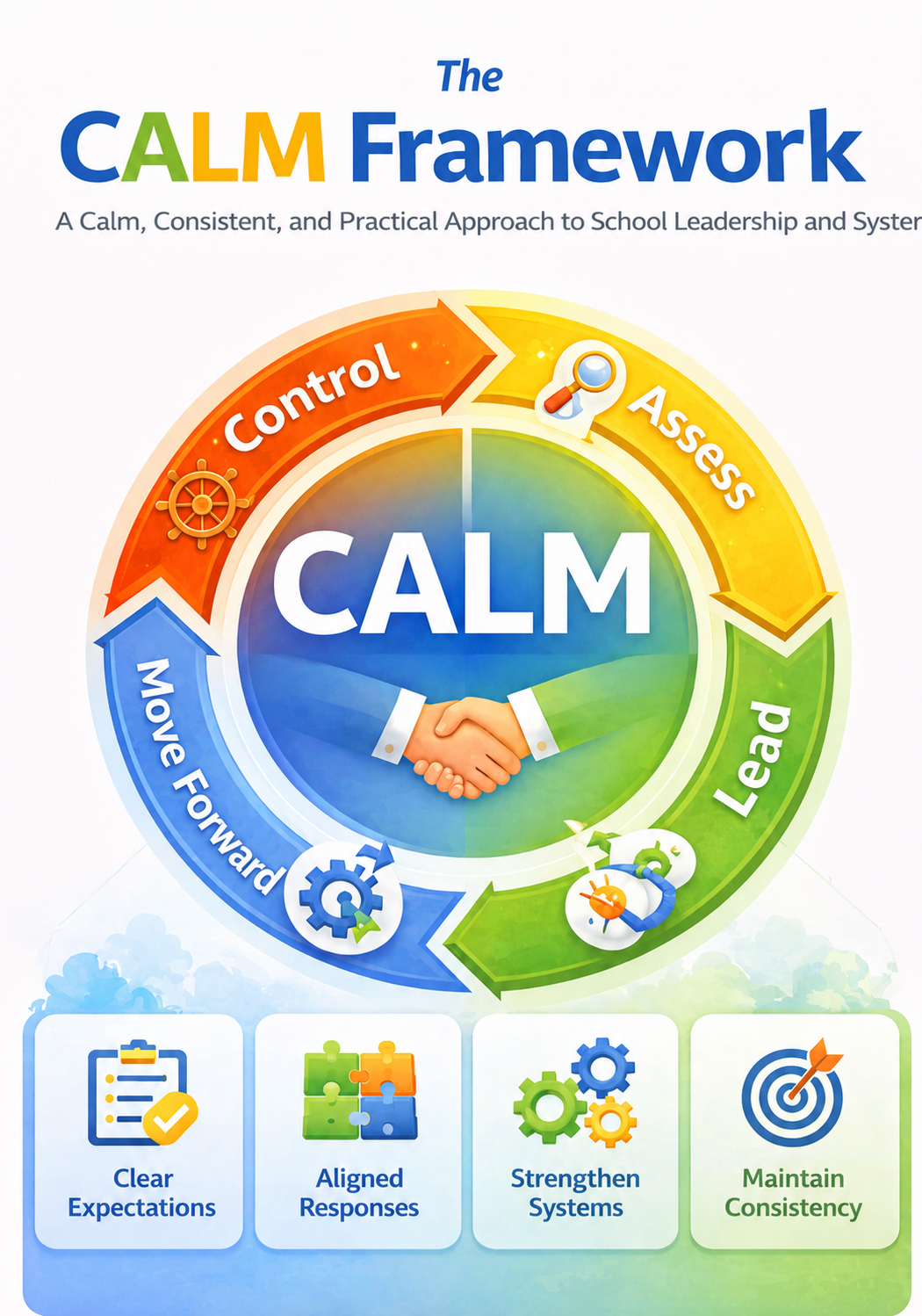
Control the Environment
Stabilize the setting and tone before solving the issue.
Assess the Situation
Pause and understand what is really happening before deciding.
Lead the Response
Respond with clarity, professionalism, and consistency.
Move Forward
Follow up, restore trust, and strengthen the system.
This approach helps leaders avoid getting stuck in repeated reaction mode. It gives them a practical way to think through difficult moments while also asking a deeper question:
Is this just a moment to manage, or is this a system that needs to be strengthened?
That question can change the direction of school leadership.
Strong Systems Support People
One important point: systems should not feel like “one more thing.”
School leaders and staff already have enough one-more-things. Most of them are hiding in inboxes.
Strong systems should make the work clearer, more consistent, and easier to sustain.
A good system helps people know:
What should happen
Who is responsible
When action should be taken
How communication should flow
What follow-up is expected
How the school will learn from recurring issues
The goal is not to turn schools into rigid machines. Schools are human places. They require judgment, relationships, flexibility, and care.
But without clear systems, even the most committed people can become overwhelmed by repeated confusion.
Strong systems protect people from unnecessary stress.
What Schools Gain When They Move Beyond Reactive Leadership
When schools move from reactive patterns to proactive systems, the benefits can be felt across the building.
Administrators can make decisions with more confidence.
Staff can trust the process.
Students can experience more consistency.
Families can receive clearer communication.
Leadership teams can spend more time improving systems instead of constantly putting out fires.
And school culture can become more steady, predictable, and supportive.
That does not mean every day becomes calm. This is still education. There will still be surprises, schedule changes, emotional moments, and hallway mysteries that nobody can fully explain.
But strong systems can help leaders respond with more clarity and less chaos.
Final Thought
Reactive leadership is often a symptom of overloaded leaders and underdeveloped systems.
The solution is not simply to work harder. Most school leaders are already doing that.
The solution is to build practical systems that create clarity, consistency, and support.
When schools move from reactive leadership to proactive systems, everyone benefits: administrators, teachers, students, families, and district leaders.
Calm does not happen by accident.
It is built through intentional leadership and sustainable systems.
If your school or district is looking for practical support around leadership consistency, recurring challenges, and stronger systems, visit Administrator Avenue Consulting Services or connect with Joe.
